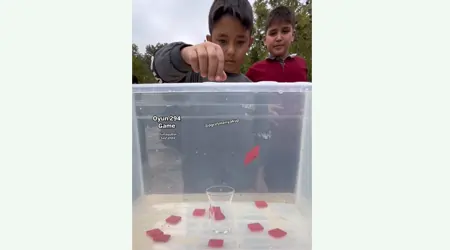
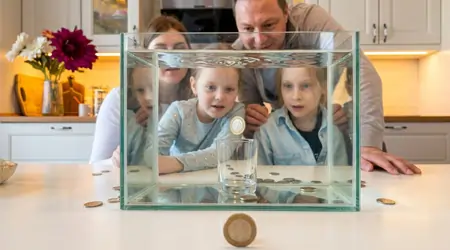
How much do you trust your eyes? What about your dexterity? We are here with one of the most popular family activities on social media, which seems like child's play at first glance, but which fascinates everyone who tries it for hours: Dropping a Coin in a Glass in a Water-Full Aquarium Game!
It has both wonderful physics and serious hand-eye coordination behind it.
So, how to play this game, which you can set up at home in seconds? Is there a secret tactic to make the money hit the glass? Here are all the details!
Materials Required for the Game
All you need for this fun game that costs almost nothing is:
- A large transparent container or aquarium (It is important that it is glass so that the inside can be seen easily).
- A small glass cup.
- Plenty of coins (Different sizes make the game more fun).
- Enough water to fill the door.
How to Play Dropping a Money in the Cup Game? (Rules)
The setup and rules of the game are quite simple, but hitting the target is a matter of patience!
- Do the Setup: Fill your deep glass container or aquarium to the brim with water. Place the small glass glass in the middle of the water, perpendicular to the bottom.
- Shooting Position: Players take turns in front of the aquarium. He tries to drop the coin in his hand into the glass at the bottom by releasing it from the upper surface of the water or by lightly throwing it.
- Scoring System: The player who manages to drop the money into the glass wins the grand prize, or the one who hits the most money becomes the champion of the day.
Why Is It So Difficult? (The Physics Behind It)
Even if you drop the coin from the surface of the water at exactly the level of the glass, the coin will never go down in a straight line. It floats left and right, wobbling like a leaf, and sinks to the bottom. So why?
- Resistivity and Density of Water: Water is a much denser fluid than air. When the money enters the water, the resistance (frictional force) applied by the water to the money slows down the money's speed.
- Turbulence and Chaotic Movement: The coin does not have a completely smooth hydrodynamic structure. As it descends, small water eddies (turbulence) form around the edges of the coin. These vortices constantly push the money left and right and divert it from its path.
Are There Secret Tactics for Dropping Money in the Cup?
If you're tired of constantly missing, you can try a few scientific tricks to increase your chances:
- Leaving the Coin Upright: Instead of dropping the coin horizontally (flat) into the water, try dropping it so that the angle of entry into the water is completely vertical (90 degrees). This can reduce the resistance of the water, allowing the coin to go more smoothly.
- Change the Size of the Coin: Small and light coins are more affected by water currents. Choosing larger and heavier coins can make it easier for you to hit the target as it will increase the gravitational effect.
- Get Close to the Water Surface: Instead of dropping the coin from a very high altitude, dropping it right on the surface of the water prevents the initial velocity from losing its direction.
Conclusion: The Most Fluid Form of Family Fun
If you want to leave the screens aside and have an evening full of competition and laughter as a family, the challenge of dropping a coin into a glass at the aquarium is the activity you are looking for. While it increases children's focus time, it also offers a fun challenge for adults.
Did you manage to catch the glass in this game? What size coin did you hit the most with? Share with us in the comments!