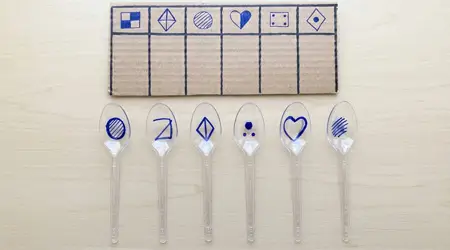
This practical activity, prepared with transparent plastic spoons and cardboard, improves children's visual perception, part-whole relationship and focusing skills. Details of the educational game are here!
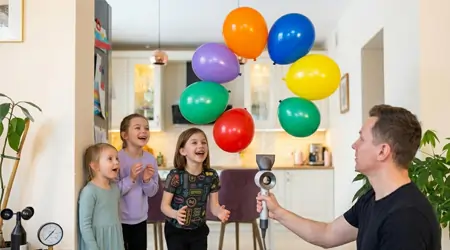
Make your children love science with materials at home! Rules and procedure of the balloon circle experiment that rotates in the air using a hair dryer and balloons.
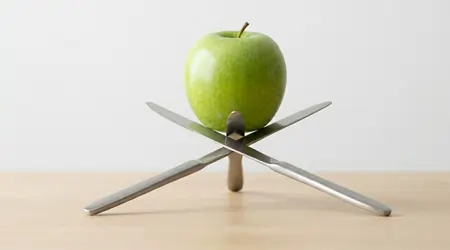
Defy gravity with ice cream sticks, thin branches, or knives! Discover the construction and scientific secrets of the "Self-Supporting Bridge" (Da Vinci Bridge), which can carry heavy loads using only friction and balance, without any glue.
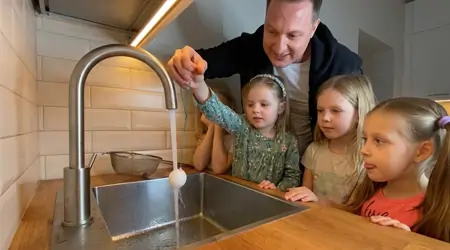
A fun and educational science experiment you can do at home with children: A ping-pong ball suspended in the air in a stream of water! Learn Bernoulli's Principle in simple terms and try this magical experiment right away.
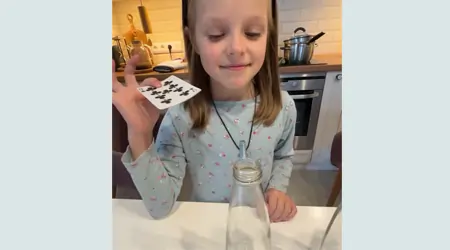
This content; It describes an interactive experiment performed with a bottle, a card and a small object that teaches children the rules of physics (inertia) through play. It offers tips on how to diversify the game with different materials such as batteries, pencils or nuts.
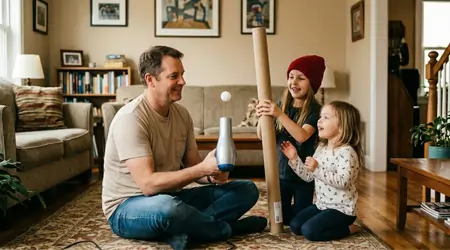
Discover science with simple ingredients at home! Explain Bernouilli's Principle to your children in a fun way, using a hair dryer and a ping-pong ball. Step by step experiment guide.
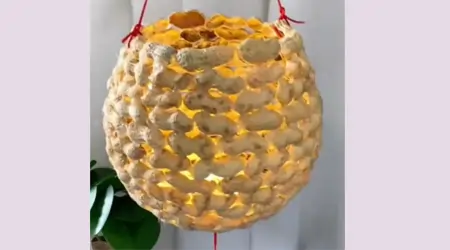
This project describes the process of making a naturally textured beehive model with peanut shells glued around a balloon. The structure that emerges by dismantling the balloon after the glue dries offers an educational and entertaining recycling activity for children.
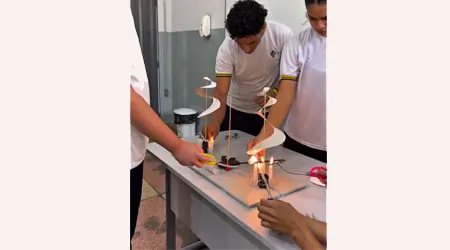
Why does heat rise? Why does hot air move? This fun experiment allows children to feel science firsthand by observing heat and air currents. This experiment, which you can easily do at home or in the classroom with a candle and a small spiral of paper, is both instructive and fascinating!
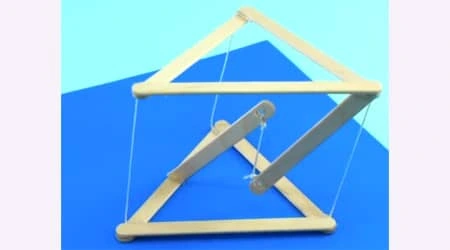
A magical structure that defies gravity: What is an anti-gravity table? A fun physics experiment you can do at home using the Tensegrity principle.
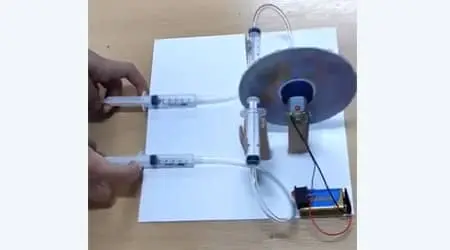
In our experiments series, we are trying to prepare a device for the Pascal Principle and try to make a braking system.
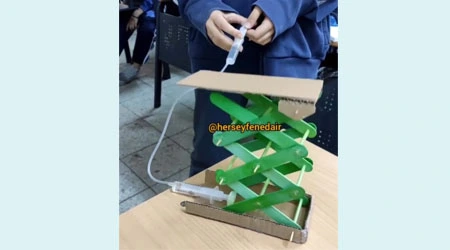
In our experiments series, we are trying to prepare a device in accordance with the Easter Principle and make leverage.
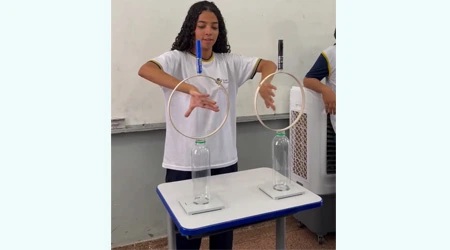
An interesting experiment that we can test Newton's three laws at the same time! Students will see the 1st law (law of inertia) by lifting the circles with their hands, while falling objects will see the falling objects. Students will experience the circles with their hands and experience the 3rd Law (Impact-Response Law).
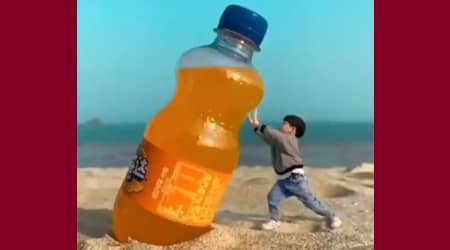
Discover the "Wonderland with Photo Tricks" activity using perspective and optical illusion techniques! A step-by-step guide to developing visual perception and creativity in children.